Thursday, April 19, 2012

My Writing Routine

A Really Bad Poem by Susan McBride

How is it done? I'm often asked
About the task
That’s my love and my livelihood.

Are you chained to your desk,
Not leaving your nest
Until your word count’s in the can?

I wish I could say,
“Hey, this is the way”
I always tell my stories.

But every book’s a new deal,
I don’t know how I’ll feel
Or what’ll crop up and annoy me.

When deadlines loom
Emails boom
And laundry piles up.

Something breaks or leaks
My husband freaks
And I wait for the repairmen.

I have author friends
More disciplined
Who write everyday like clockwork.

Some in car pool lanes
(which I think is insane)
or at Starbucks while the joe perks.

I admire the ones
Who don’t miss a beat
With second jobs and kids at their feet.

I just try to keep
My butt glued to my seat
And hope nothing gets out of hand.

But crises always arise
Things I never surmised
That throw me off my game plan.

So when I’m asked
How I do this task
I don't always have an answer.

“I don’t know,” I'll admit,
It’s a mysterious bit
Then I'll shrug and say, “It’s magic.”

***

Susan McBride is the author of Little Black Dress, The Cougar Club, and the forthcoming The Truth About Love and Lightning (William Morrow Paperbacks, 02/13). At nearly eight months pregnant, her writing routine is pretty well shot to hell, which is good practice for after the baby comes. 

Wednesday, April 18, 2012


Dear Girlfriends and followers: I was scheduled to post on the 1st anniversary of my father's death.  I have asked my dear friend, and honorary girlfriend (okay, he's male) to step in for me.

Guest blog by Jon Jefferson, bestselling author of The Inquisitor’s Key, due out May 8 from William Morrow.

I write murder mysteries; forensic thrillers. My pages are populated by corpses and skeletons; rivers of blood run from my scenes. Imagine my surprise, then, to find myself devoting many chapters of my latest novel to one of the most famous romances of all time. How the hell did this happen?


Well, one thing leads to another; take enough steps, and you’ll walk a thousand miles, even if they’re meandering miles rather than crow-flight miles. My first step was deciding to set a crime novel in Avignon, a beautiful, walled city in Provence that was the seat of the popes for most of the 14th century.

To do justice to Avignon, I realized, I needed both a modern-day murder and a medieval mystery, one set during the lavish heyday of papal Avignon. (The court of Pope Clement VI – “Clement the Magnificent” – cost 10 times as much to maintain as the court of the French king!) Not surprisingly, medieval Avignon boasted a fascinating cast of characters. One of them was Jacques Fournier, a heretic-obsessed Inquisitor (he of the book’s title) who tortured and burned his way all the way up to the papal throne, becoming pope in 1334. Another was Petrarch, a wonder-boy cleric who wrote history, philosophy, and poetry – reams of poetry – on the Church’s dime. In Avignon, Petrarch fell famously in love with a beautiful young countess – a married young countess – named Laura de Noves. Apparently Laura was more committed to her marriage vows than Petrarch was to his chastity vows, for she refused to be wooed. Petrarch worshiped her from afar … and yet from near enough that his broken heart could be seen by Laura and everyone else in Avignon. He channeled his love into sonnets – hundreds of sonnets – extolling her beauty and virtue. He even hired a prominent Avignon painter, Simone Martini, to paint a miniature portrait of Laura, one he could gaze at whenever he wished to refresh his memory or rebreak his heart. So far, mind you, we’re squarely in the realm of historical fact.

All that unrequited, sublimated passion set my fiction-brain to thinking: What would it be like for the painter, Martini – to follow the young woman, secretly observing her in the streets or at church, sneaking glimpses of her in profile, in half-profile, full-face? Gradually, as I began mentally pursuing the lovely Laura, I realized that it would be easy for Martini to become obsessed: infatuated with the subject of his artistic observation, his painterly voyeurism. Then I thought, And what if she one day she catches him, confronts him, demands to see the surreptitious portrait? My next step was to write this:

One Sunday as she kneels, he sees her head slump and her shoulders slacken; then, with a jerk, she awakens, wide eyed, and suddenly he hears her laugh—in church!—when she realizes what she has done. The matron beside her gives a sharp, reproving look, and she forces her face back into its mask of composed piety. But Martini has now seen something else behind the church-face mask, and his curiosity is aroused.

That night, as he lies beneath the covers before going to sleep, he plays a painter’s game with himself, imagining how he might paint her face in various scenes, with various expressions and emotions: worry, gratitude, tranquility, terror, irritation, delight, lust. And then, when Giovanna rolls her body against his in the dark, and her fingers seek him out, stroke him to hardness, and guide his flesh into hers, it is Laura’s face, and Laura’s breasts, and Laura’s moans that he imagines, and that make him gasp and shudder with a fiery passion that Giovanna’s simple, honest love has never managed to ignite.

The next Sunday, she is not there. He checks her usual stations—the side chapels where she always pauses to light candles—scanning the congregation with confusion and growing dismay. Somehow, because she has always been here, he has taken it for granted that she always would be here. His surprise gives way to another feeling, one he recognizes as fear—no, as panic! What if she’s gone for good—moved away to Paris, or killed by a sudden fever? How can he possibly finish the portrait until every detail of her is etched in his mind? How will he explain his failure to Petrarch? And then: How will he fill his Sunday mornings, and the other hours of his days and nights that she has come to occupy? Good God, he thinks, I am worse than the poet. I have a good wife, a sweet and faithful woman who loves me, and yet I am turning into a schoolboy over this woman—this girl—who is thrice forbidden to me: She is married, I am married, and she is beloved by my friend Petrarch.

In a state of consternation, he stumbles over the feet of worshipers, turns up the side aisle of the nave, and makes for the door. Just before he reaches it, he feels a tug on his sleeve. He turns, and there—hidden by a pillar—is the woman herself, a sight so unexpected he almost cries out in surprise. She watches him regain control of himself, then says, “Monsieur, vous me cherchez?”: Sir, are you looking for me?’’

For a startled medieval painter named Simone Martini, that encounter will change things forever. Who knows: perhaps it’s also a turning point for an equally surprised, meander-prone writer of crime fiction … or is it historical romance?

#          #          #

Jon Jefferson writes in Tallahassee, Florida, where he lives with his wife, the peerless Jane McPherson – to whom he was introduced three years ago by Sheila Curran, blogger, novelist and matchmaker par excellence. For more on The Inquisitor’s Key, visit JeffersonBass.com and Jon's author blogspot. And check out the book’s high-octane, 30-second YouTube video trailer.

Judging a Cover By Its Book

by Ariella Papa


I never met a cover of mine that I didn’t like. I know some authors who hate what they wind up with, but not me. From the first time I saw the sketch for my debut novel – there were donuts worked in-  to every random copy of my novels in numerous translations, I love them all. I have a couple of covers framed in my house and one day when I win that Mega Millions jackpot or get that big option, I will wallpaper the writer’s room in my eco-friendly lake house in book covers. The Danish version of Up&Out is super cool (at least I think that’s what it is).
I guess it’s because when I see the cover I know that the book is soon to follow and I am grateful again that this is all happening. Maybe if I were a NY Times bestselling author I would be more picky, but I doubt it. I love seeing the way an artist decides to translate my book.
Things are a little bit different now that I am epublishing. I am told that covers aren’t as important in epublishing. People who buy ebooks aren’t browsing covers they say, but I don’t know if I buy it. Either way, now that I intimately involved in the process of creating the cover, I definitely want it to be good.
I am lucky that I am good friends with someone who makes covers for actual books for a real publishing company and she (I’ll call her Joan since we both like Mad Men and she is a sassy redhead) will trade a good meal for a book cover. It’s a win-win for me, because I love her style and this is great reason to go back to Brooklyn Fare.
For my first epublished book Momfriends Joan gave me three different options. We went with a style that would appeal to my chick-lit fans. The cover was pink and had three different sets of shoes to represent the three women in the story. I asked for a tweak of the middle shoes to differentiate it more from the other two and Joan put in the cute blue kicks she happened to be wearing. I loved it. It totally got the vibe of the book.


Then I decided I was going to epublish some short stories. All of these stories were set around Y2K, and sort of went together in my head. What I really needed was six separate covers. I needed covers that were different, but tied together. It was probably time to move away from pink. Joan suggested keeping some stylistic elements like my name placement and certain typography. I suggested incorporating some iconography from the stories and this is what we wound up with.

Again, I love it! As I release each story that story's name will be the boldest, but all the names are still there. I’m working on a little trailer based on the cover.
I’ve wanted to publish these Turn of the Century Stories for some time and I will be epublishing one every couple of months over this year. It’s kind of an experiment and we’ll see how it goes.  In content and cover this is a departure for me and I’m looking forward to seeing how it turns out.
 Because these books are epublished and I don’t get to hold the tangible book, seeing this cover was the moment where I started to feel like this book was going to be real.

 What are YOUR cover stories? Are you always happy? Is epublishing changing how you think about them?

Ariella Papa is releasing Turn of The Century Stories all year long. Find out more about her at ariellapapa.com or like her on facebook http://www.facebook.com/ariellapapabook

Monday, April 16, 2012

How to Begin by Deborah Blumenthal


How to begin?

Writing the first sentences of an article or book are the hardest, at least for me.  They have to be perfect before I go on because they set the stage for everything that follows, hinting at not only where the story will be going, but also letting readers know they’re in capable hands.

After watching six mesmerizing hours of Gatz, the Public Theater's reading and dramatization of the entire text of The Great Gatsby,  I went back to look at the opening lines of  this iconic work:

In my younger and more vulnerable years my father gave me some advice that I’ve been turning over in my mind every since.

“Whenever you feel like criticizing anyone,” he told me, “just remember that all the people in this world haven’t had the advantages that you’ve had.”

The morning after the show,  which started at two on a Sunday afternoon and ended at ten fifteen at night, including a dinner break, I went back to those lines and marveled at how they put the entire book in eye-opening perspective.   Although few books can compare to Gatsby, I scanned my book shelves to see how others began their stories. 

The opening paragraph of “Sweet Dreams Baby,” a novel by Sterling Watson,  is one of my favorites:

I look out through the back door screen to see if the Pultneys are there. One of them is, Jimmy. I’m scared of the Pultneys, but I don’t say so. Dad says never say you’re scared and you won’t be. Jimmy Pultney has a chicken in one hand and a hatchet in the other.  He holds the chicken by the next, and the neck stretches long. The chicken doesn’t try to get away. It hangs quiet, knowing it can’t. The chopping block is an old hickory stump. My dad says the Pultneys probably dragged it with them from some holler in the Ozarks. He calls them Okie trash.”    

Okay now you can let go of that breath!

Another favorite opening is from Lolly Winston’s “Happiness Sold Separately.”

Elinor Mackey is cleaning out her purse, try to lighten her load, wondering how a broken sprinkler head wound up among the contents, when she first learns that her husband, Ted, is having an affair.

You're hooked, right?

What are your favorite opening lines or paragraphs?  Why do you love them? Share your favorites!

Deborah Blumenthal is the author of thirteen books. Her latest young adult novel, THE LIFEGUARD, was published last month by Albert Whitman & Company.  


The Author to Her Book by Hank Phillippi Ryan

HANK PHILLIPPI RYAN: The time is almost here. My new book is coming out, in a few months, and there's nothing more I can do. I love it, in fact  I'm thrilled with  it. But it is what it is. Sometimes, I pick up the (very gorgeous) advance reading copy--here's a confession for you--and open to a random page, and just start to read. Simply to see if, say, some reader chose it in a library or bookstore, and just flipped to a page and started reading, would they like it? Would they want to buy it or check it out?

This is, of course, absurd.  (Ah, Isn't it? Trying to pretend I'm "not-me" to test how a random stranger might react?) 

Now, soon, people will be getting copies of it. And reading it . And I love the book, I do, but there's always the moment when you send the baby out into the world and say--fly! fly! fly! Okay, I'm madly mixing metaphors, but you know what I mean. It's terrifying--and so exciting.

The other thing about being a writer is that we alwyas feel--it's only me. Just me. I'm here by myself, loving this but worrying, and no one else can understand. And then, a dear pal sent me this poem.

Written in 1650 or so! To me, it comes from love and pride and the bond a writer feels to her work--and a sweet affection for her "offspring." Anne Bradstreet was born in 1612. And emigrated to Massachsetts in 1630.  We certainly share the frustrations of editing...don't you love when she  rubs off a spot--only to find another flaw? It's fascinating to think about her--almost 400 years ago!--having some of the same feelings we all do now.
 

Apparently some of her acquaintances took her poems, and had them published against her wishes. And tht proably wouldn't happen today!And I don't agree with all of her emotions, of course...do you? But I do love the sisterhood and the common ground. And the idea that though many things change--can you imagine Anne Bradstreet seeing her poetry in an e-book?--so many things for writers are universal and constant, transcending time. 
She might even have become a "Girlfriend," right?
The Author to Her Book
     
     
Thou ill-formed offspring of my feeble brain,
Who after birth didst by my side remain,
Till snatched from thence by friends, less wise than true,
Who thee abroad, exposed to public view,
Made thee in rags, halting to th' press to trudge,
Where errors were not lessened (all may judge).
At thy return my blushing was not small,
My rambling brat (in print) should mother call,
I cast thee by as one unfit for light,
The visage was so irksome in my sight;
Yet being mine own, at length affection would
Thy blemishes amend, if so I could.
I washed thy face, but more defects I saw,
And rubbing off a spot still made a flaw.
I stretched thy joints to make thee even feet,
Yet still thou run'st more hobbling than is meet;
In better dress to trim thee was my mind,
But nought save homespun cloth i' th' house I find.
In this array 'mongst vulgars may'st thou roam.
In critic's hands beware thou dost not come,
And take thy way where yet thou art not known;
If for thy father asked, say thou hadst none;
And for thy mother, she alas is poor,
Which caused her thus to send thee out of door.  

HANK: How do you feel at those turning point moments for your book? How do you handle the nerves? I say to myself--this is what I dreamed of! So now--enjoy it. 

(THE OTHER WOMAN is the lead title for Forge Books' fall catalogue...Lisa Scottoline says "Riveting!"
find out more at http://www.HankPhillippiRyan.com )


Thursday, April 12, 2012

Those Elusive Ideas by Lucy Burdette

Ideas for books and stories are everywhere out in the world--it's putting my finger on them that's not so easy. But here's an example of how a story evolved--the pieces were all there; I simply had to put them together.

Every year Mystery Writers of America publishes an anthology of short stories centered on a theme that is chosen by a big name guest editor. Two years ago, the editor was Nelson DeMille and he called for stories based on the very rich.  I very much wanted to be included, so I racked my brain for ideas. At the time, I was staying in Key West and my sister and her husband had come to visit for a couple of days. We wandered down to Mallory Square, where the sunset celebration takes place every night. The big cruise ships dock there too, though almost always they are required to set off before sunset so they don't block the tourists' view.

On this particular night, one of the ships seemed to be delayed. And then we spotted a man carrying his luggage off the boat, by all indications arguing with the crew. He steamed off into the crowd and the ship left the dock. Now that got us all thinking...and finally we came up with these ideas: What if his girlfriend had not returned to the boat in time to depart the port? And what if a detective from out of town happened to be watching, and had seen the same man squabbling with a woman on Duval Street earlier that day? And what if her picture turned up as a missing person in the crime report of the Key West Citizen the next day? And what if the cat man of Key West had seen something that turned into a clue?

All I had to do was to figure out what happened to her....

And where the detective had come from and why he was there...

And why he preferred to spend his vacation in Key West helping the local cops solve a crime...

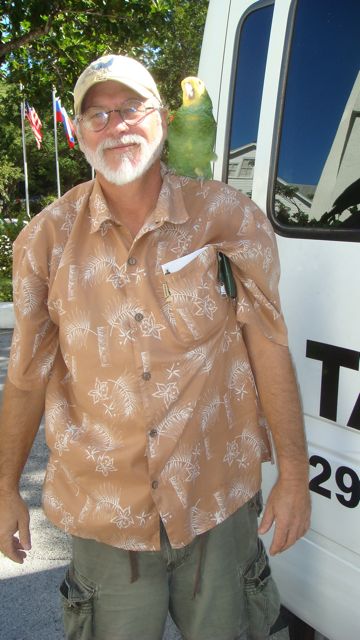
The last part was the easiest. I borrowed Detective Meigs from my advice column mysteries and gave him an unwanted, nonrefundable vacation from his sister. And had him greeted at the airport by a taxi driver with a parrot on his shoulder.

And out of all that emerged my short story "The Itinerary" (by my alter-ego Roberta Isleib), now published in THE RICH AND THE DEAD, edited by Nelson DeMille. And even better, nominated for an Agatha Award at the Malice Domestic convention!

Here's how it begins: 

"Detective Jack Meigs knew he’d hate Key West the moment he was greeted off the plane by a taxi driver with a parrot on his shoulder. He hadn’t wanted to take a vacation at all, and he certainly hadn’t wanted to come to Florida, which he associated with elderly people pretending they weren’t declining. But his boss insisted, and then his sister surprised him with a nonrefundable ticket: He was screwed." Read the rest of the story here.

Lucy Burdette aka Roberta Isleib is the author of nine mysteries including the first Key West food critic mystery, AN APPETITE FOR MURDER. Please follow her on twitter or facebook.

Author Promotion: What Worked, What Didn't

I'm a big believer in Skyping with book clubs all over the country. It's very folksy like a fireside chat, with all these women sitting in someone's living room or kitchen glued to a computer screen. But it's a great way to interact, answer questions, have a few laughs and endear yourselves to readers you would never otherwise have met. They love it, I love it and it costs not a dime. But if you try it, I suggest doing a trial run with the group host before the actual "meeting". Work out all the technical kinks and you're good to go. Worth the extra time, and it's also a way to review how you want to work the discussion. Generally I begin by talking about my writer's journey, I discuss the book and then take questions. The whole thing takes 20-30 minutes and everyone is happy.

Saralee Rosenberg

Good: I wrote personalized letters to booksellers and sent them ARCS. My efforts resulted in my novel being a Booksense Notable (Which is now Indie Bound.)

Bad: I wasted too much time on bookstore appearances. Lots of time only a few people would come out, so now I mostly do drop-in signings where I just sign stock and chat up booksellers.

Karin Gillespie

I obsessed over the launch of my debut novel with the same degree of passion applied to the birth of my first child.  No detail was too minor, no expense spared, and all chickens were counted as hatched.  My published friends counseled restraint.  “Just do what you like to do,” they said, “because, in the end, none of it will matter.”  I listened, but their words were confused by memories of those very authors, besotted with their debut novels, pumping blind enthusiasm into the dead-on-arrival veins of book signings, action figures, and t-shirts.  My advice?  Just do what you like to do because you love your book—and enjoy it while you can.  Your next book will have to hit the ground running.        


Cindy Jones


I am on day six of an eight day blogads campaign, and so far the results have been disappointing.

Deborah Blumenthal

What worked
Whenever I do a reading/signing, I bring "autographed copy" stickers, and tell the audience I have them. I mention that they make a nice addition if you're giving the book as a gift. This gives people the idea to actually BUY the book as a gift for someone. And I believe it increases sales all around. (Even grown-ups like stickers!) 

FYI, I get mine from Alpha Business Forms.

What didn't work
I once tried giving away prizes to get people to help spread the word about my books, and it wasn't as effective as  I thought it would be. Turns out, people actually LIKE to help, and would rather do it out of kindness and generosity than for a reward. So although the program didn't work out, it was an uplifting lesson about human nature!

Ellen Meister


What I believe has worked best for me promotion-wise throughout my career is just getting to know the book people in my city and developing a really lovely relationship with them. It's so nice when they email and say, "There's this cool event coming up, and we'd like you to participate." Also, taking every opportunity to meet booksellers and librarians in other cities and states, say, through book festivals or trade shows. It's such a different feeling meeting them face to face, and I've made some really wonderful friends that way. And it's been crucial getting to know the folks at my publishing house through the years (I've been with HarperCollins since 2002 when I signed my first contract with them--wow!). They're my book family, and I appreciate the ease with which I can communicate with them and share ideas.

What didn't work was spreading myself too thin, trying to do too much promotion-wise (like, travel anywhere and everywhere anyone would have me, go to every convention or conference I could possibly squeeze in, etc.). I did get very good at writing a book in three months because of backing myself into a corner time-wise; but I've realized things work out much better if I focus on the writing and keep my butt in the desk chair these days. I've learned it really is okay to say "no" every once in a while!

Susan McBride


Some of the low-tech stuff I did, business cards with the book cover, and a book party that also raised money for a charity tied to the theme of my book, seemed to me to have more 'legs' than others. My huge failure, 500 window decal bumper stickers with Diana Lively is Falling Down to stimulate intrigue among drivers.  I'd say 10 people, all family and close friends, put them on their cars, I was too shy to press them on anyone else, and they remain, to this day cluttering my file closet. 

The worst promotion, for me, has been doing  'readings' at Borders (pre-bankruptcy) and Barnes & Nobles out of town.  As my friend Mark Winegardener says, "It's like going to the bathroom in public."  Worse, yet, when no one shows up to witness the event, it's somehow even more humiliating!  If you've got a big name, it might be different, but for me, it was simply a waste of the miles on my car and lots of nervousness ahead of time.  I signed all the books I could, knowing they couldn't return them, but still...

The best advice I got was to do what you love to do anyway, and forget the rest.

Sheila Curran


Aah, promotion.  The bane of every author's existence!!  In my experience, it's really hard to tell what works and what doesn't.  There's really no way of knowing what exactly drives people to buy books.  Sure, an ad in People Magazine couldn't hurt, but does that really encourage people to buy?

So, I think it's a really good idea to just do what you're comfortable with.  That having been said, having a website, blog and Twitter account, I think, are a great place to start.  Getting your name out there is always a good thing.

Brenda Janowitz


 What worked:
Bookmarks have always been a good giveaway for me. I have some made with each book. I put the cover of my new release with a blurb on the front. I put the covers of the other books in the series on the back so that readers will have all the titles listed in order. I use them at signings and to hand out to family and friends. 

Waste of Time: 
T-shirts for a panel. Years ago I was on a panel at a convention with several author friends. We blogged together at a now-defunct blog called Good-Girls-Kill (We wrote mysteries.) We came up with idea of wearing t-shirts for the panel to promote our blog. We found an on-line company that printed customized t-shirts and decided on long-sleved black t-shirts with the blog address on the back. 

The problem was that by the time we decided on logo/no logo, font size, slogan, color, long/short sleeve, regular/baby doll fit, etc the deadline for the con was fast approaching. We had to rush the t-shirt order and have them FEDEXed. In the end, the shirts cost an outrageous $80 each. My friend Diana Killiian quipped she was going to be buried in hers. Definitely not worth it! 
Sara Rosett


Obviously, good reviews were a plus, but other than that, I think networking with other writers.