Monday, June 24, 2013


Reinventing The Self:  We Always, Always Change
By Sandra Novack


Years ago, I got an octopus tattoo on my back, because I related so strongly to the symbolism of this ancient cephalopod.  The octopus can quickly change color and blend with its surroundings and seemingly disappear; it is known for its constant adaptability, clever diversification, ability to "feel out" things, and its art of camouflage.  In short (and among many, many other things): It’s a great master of disguise.

Given my love of the octopus, it’s probably no surprise that I might be a fan of the word ‘reinvention.’   I am the first person to switch gears, step back, dart off, or otherwise change course when my intuition guides me to do so.  I seldom look back once on a new trajectory.  I actively seek out new “dens” as needed, for growth, security, or just a place to call “home” for a while.  My motto:  Change is good!  Reinvention?  We require it.

As writers we are always, in a way, reinventing things.  The very act of writing is a radical (and political) subversion of “normal” expectations, a way to actually reinvent the world we all live in.  (Can someone call us all anarchists? It's not far from the truth!)  In lesser ways, each time we start a new book, we are taking up a new way of thinking and feeling.  When we add characters to our new fictional worlds, we are constantly shifting gears, exploring new temperaments/passions/careers/habits that may radically be different from our own.  When our work comes out to the public, we put on new hats, magically becoming PR people, that vision (hopefully!) of those who are actually comfortable doing things like touting our own work, giving interviews, talking on radio or TV, answering questions on a dime, all with grace and verve.  We do this even if we are otherwise quiet homebodies.

On a personal note, there are other ways I’ve reinvented myself over the years.  I wasn’t one of those people who “always wanted to be a writer.”   I started writing seriously in 2001, started publishing (over thirty) short stories from 2003-2006, and then started a novel.  I switched gears from shorter to longer forms when I realized novels just sell better, and when I genuinely just had more ‘stuff’ that I wanted to put on the page.  Those were natural reinventions, but really all my reinventions have felt that way—natural, what I wanted, rather intuitively, to do next.

My work has been considered ‘literary’ fiction, though lately I’ve been hearing (and embracing) the word “commercial”, so, in a way, I’ve shifted gears again, to make my newest work much more plot-driven (action, action, action) and “high concept.”  During this, I have SEVERAL times fantasized about sticking a pen name on it and sending it off to the world that way.  I know quite a few writer friends who have changed names or have been asked to change names to reinvent themselves.  Most take umbrage to that, given that they work so hard to build their list.  I totally understand that.

But sometimes I look at it another way:  I am inherently shy, dread reviews (even when they are starred and wonderful—can someone please tell me to relax!), and I would love nothing more than to slink away from my own name, from time to time.  I always figure, hey…if you totally deviate from your “platform” and a book does great, you can always own yourself back (See that awesome selling book…that’s ME!).  And if you try something radically different and it doesn’t do well, you can just disown it completely (that’s not my baby!) and go back to doing those things people know about you.  In all this, you still get to write and make a living.  

 Though it remains a fantasy (i.e. no one has asked me to do this, even though I often think about ‘pitching’ the idea), it makes me slightly giddy to think I could become my own fictitious character, another writer who does things no one named “Sandra Novack” would ever do.  I think it could be quite liberating!  

The octopus in me agrees.   


Sandra Novack is the author of the novel, PRECIOUS, and the short story collection, EVERYONE BUT YOU.  Currently she is working on a novel, THE PEACOCK ANGELS (name still sticks!).  Visit her at: http://www.sandranovack.com.

Sunday, June 23, 2013

The Alphabet Soup of Perfect Timing

By Laura Spinella

The right words. I’ve been thinking about that a lot lately—113,724 of them to be exact. I’ve looked at them microscopically and fussed over each one like the bow on a baby’s hat. We are past the collective stage, the part where you consider words as a whole and the story they tell. Edits have come and gone and so has the window in which one can easily shift ideas, reroute action, or change a character’s motivation. The next time I see Perfect Timing it will be typeset with a giant note on it about how now is not the time to make extensive revisions. I’m down to wringing my hands over lone words—a curious irony of the trade.
            Perfect Timing is a book I wrote in stages. It was my in-between novel.  Something I worked on while Beautiful Disaster simmered and Valley Views from Abbotsford, PA, made its way in and out of my head, finally making its way to a permanent address in my desk drawer.  We’re talking years here, and during that time I never thought about Perfect Timing in terms of publication. Actually, I never thought of it as Perfect Timing.  Back then it went by a different title, the words adding up to a rather different story. This was my feel-good composition, my comfort food while struggling to find the right words in other books and fielding the real rejection attached to this dreamy endeavor. Nowadays it’s all email, but back then I read so many snail-mail rejections I developed envelopaphobia—a fear of mailboxes. I loved to tinker with that book, the same way Leo, who lives down the street, has tinkered with his’67 Corvair since we moved here.
            A bunch of years ago—I don’t remember how many, I found some courage, or maybe it was just a whim (courage is more dramatic, don’t you think?), and shipped that comfort manuscript off to one of the biggest agents in the business. Not long after, the agent called to say she’d been reading my words since she opened them that morning. I had this crisp vision of Laura Spinella alphabet soup spilling over her desk. Would she get my words as a collective whole? Well, she got about half of them. She loved the back portion of the storyline, gushing in fact. Unfortunately, (see how one word indicates this won’t turn out well) she merely dripped over the present-day portion. Still, she was lovely and encouraging, suggesting I rewrite and resubmit the book to her.
            Here’s the thing. I didn’t do it.
            There’s a left hand drawer in my desk and I put the book in there, not considering it again. Maybe because the timing wasn’t perfect. I also think it had something to do with preserving the book’s ability to be my go-to comfort writing. But I did tuck it away, satisfied with partial big-time validation and the inkling that its words had potential. Fast forward a couple of years. On another whim, I gave the same book to my current agent. She read it and replied with the bold notion that the time was perfect to expand upon and rewire those words. So I did.  It took the better part of a year. During those seasons of revisions, on occasion, I’d walk past Leo’s house.  He’d be there, in the throes of rebuilding his beloved Corvair. Car parts were strewn across his yard like dead soldiers, Leo standing hunched over his engine, up to his elbows in grease. That’s a fair picture for the mental work that went into the reinvention of this book—a relatable process, I’m sure, for every GBC member.
                So here I am with words—a bunch of them that are scheduled for a print run, slated for a spine, pretty cover, and a copyright. Below are a few of my favorite words from PERFECT TIMING.  They’re original words that survived the practice years and the storage years. Like my kids, I know them at glance, they are that attached to me, reminding me that old and new, all the words in this book are mine.   

“It wasn’t what people assumed.  Not that people assumed anything about Aidan and Isabel. Their relationship flew under the radar of Catswallow gossip, but it wasn’t the fare or affair the secluded setting of a dilapidated farmhouse might suggest.”—Chapter Two

“Aidan inched away, their faces but a breath apart. He’d never used this moment to convey anything so honest. In truth, he’d never used this moment to convey much of anything at all.”—Chapter Sixteen

“Her father returned to the sofa as Patrick sat in a chair where his frame pulled tight, his bearded face doubtful.  “Eric, did you not hear the part where the town’s most popular heterosexual boy, its very own Conrad Birdie, is being railroaded for the crime?”—Chapter Seventeen (maybe you have to read it in context, but those words still make me laugh)

“Seriously, Isabel, whatever’s happened between us, did you think that if you ever called I wouldn’t come?”  
  Her lips pursed tight, eyes welling.  “In a million years,” she said, arms wrapped in a straightjacket grip, “I never thought I’d call.” –Chapter Twenty-Six

Laura Spinella is the author of the award-winning novel, Beautiful Disaster and the upcoming novel, Perfect Timing. Visit her at lauraspinella.net


Thursday, June 20, 2013

5 Favorite Quotes: The Writing Process From Beginning to End

 by Sara Rosett 

“How do you write a book?”

It's a question I’ve been asked a lot, and I still don't have a good answer. 

Photo credit: clarita from morguefile.com

Instead of going with my usual vague response about ideas germinating into plot twists, character inspiration, and daily word counts, I thought I’d borrow words from other writers to explain my process. 

How I write in five easy steps:   

1. “The best time to plan a book is while you’re doing the dishes.” ― Agatha Christie

I’m always thinking about writing, stories, plots, characters, descriptions, etc. I cull ideas from news reports, snatches of overheard conversations, and other weird places like Pinterest, Facebook, and even my hair stylist (one of the best places to get story ideas, actually). Those ideas are always churning and activities like housework and long walks are great for sorting them out.

2. “Just get it down on paper, and then we’ll see what to do with it.” ― Maxwell Perkins

I literally would not be a published writer without this quote. I read it years ago when everything I had written was only a few chapters. Nothing was ever good enough:  the first line, the first paragraph, the first chapter. I got bogged down in revisions and never moved on to write the rest of the story.

When I read this quote I thought, well, if that’s the kind of advice he gave to his authors, which included Fitzgerald and Hemingway, then it was good enough for me. I decided I’d get my ideas down on paper first—the whole book—then revise.

3. “Writing is like driving at night. You can see only as far as the headlights, but you can make the whole trip that way.” ― E.L. Doctorow
Photo credit: d3designs from morguefile.com

I generally have a firm grasp of how the story begins and how it ends. I write mystery and suspense, so I know whodunit, how they did it, who the suspects are, and how everything wraps up, but that middle part is always a tad fuzzy. I’ve found once I start writing the details and plot twists come into focus as I write. 

For me, I have to get into the story to know what must happen next. Some writers know their whole book in great detail from beginning to end before they put even a word on paper. My little brain can’t hold all that info at once. I have to ease into it.


4. “Books aren't written - they're rewritten.” ― Michael Crichton

Ah, revision. I actually enjoy revising. It’s always a relief to me to get the first draft down then I can go back and clean it up. See #2 above.


5. “The difference between the right word and the almost right word is the difference between lightning and a lightning bug.” ― Mark Twain

That quote pretty much sums up the final stage of writing, doesn’t it? When I do the final edit, the line edit, I agonize over the absolute best word, wrestling with nuance and sentence flow. And, don’t even get me started on commas….   


And one more quote for fun:

Bonus Quote: “Outside of a dog, a book is man's best friend. Inside of a dog it's too dark to read.” ― Groucho Marx

What are some of your favorite writing quotes?


Sara is currently immersed in #5 (line edits) for DECEPTIVE, the third book in the ON THE RUN series, which will be out in July. 
 
 The first two books in the series, Elusive and Secretive are available now. Elusive is currently free at Amazon, Kobo, and Smashwords. 

 Publishers Weekly called Sara’s books, "satisfying," "well-executed," and "sparkling."

Sara loves all things bookish, considers dark chocolate a daily requirement, and is on a quest for the best bruschetta. Connect with her at www.SaraRosett.com. You can also find her on Facebook, Twitter, Pinterest, or Goodreads.


Sources:


Wednesday, June 19, 2013

On Wrong Words, Right Times, Maternal Reinvention, and Divine Intervention


Okay, I know I’m late to the party.  Last cycle the Girlfriends talked about the right words at the right time.  I talked about something else.  Now I’m clinging to old ways, in more ways than one.

        
My daughter turned 18 last month. She graduated from high school and leaves for college (summer session) in eight days.  Did I mention she’s my baby?  


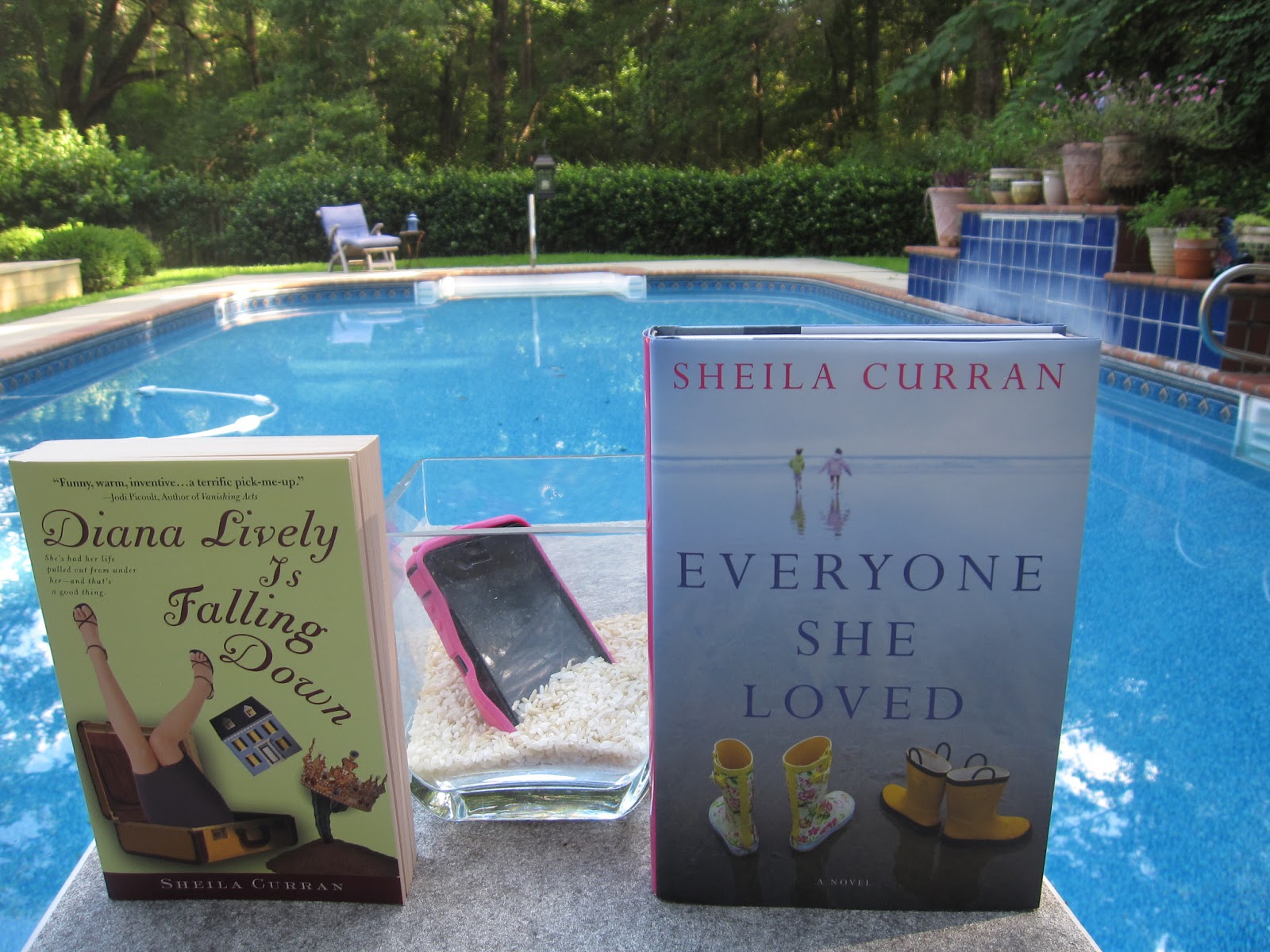
             Last Sunday, I had a rare chance to step back into old maternal shoes.  AT&T, it seems, doesn’t care if you’re 18, doesn’t care if you’ve got the credit card.  They want the account holder of record to sign on the dotted line for replacement (#3) of Steve Jobs’ prank on parents everywhere, the gift that keeps on giving.  Since when did iPhones become absolutely necessary for daily life?  It’s hard for me to argue too much: I have one (a gift?!) that I’m quite attached to.  I carry it around in an Otter cover that is, my kids tell me, a bit out of fashion, a bit on the bulky side.  

           “But it protects it!” I say, meaning so much more. 

Meaning all these things you take for granted, my lovely children of privilege, these weren’t items I grew up expecting or having.  Meaning, the world has changed and I’m fearful for you, fearful I may have spoiled you with my tendancy to err on the side of safety.  (We bought our teenage drivers new cars with the latest in side-curtain air bags and 5 star crash ratings.  The luxury they enjoyed was incidental to our need to know we’d done the best we could to protect them against the #1 cause of death in teens and the # 2 cause of anti-anxiety medication in parents.)
  
The iPhone sort of came along accidentally. It came as a celebration of being 16.  It turned into the guest that would not leave.  This gadget insinuated itself into all of our lives with its charming features, the photos we treasure, the music we adore, the texts saying “I’m safe!” Mine has my yoga apps and my Audible books.  I use the alarm.  I’ve come to rely on it.

            That said, I know it’s a luxury.  So, what’s a mother to do when her otherwise perfect daughter doesn’t use the suggested protective cover and breaks (and soaks) said iPhone for the third time?  I felt some sort of lesson was in order.  

She drove, I lectured.  Softly, but surely, I pressed my case: taking care of her things, there must be consequences. If this happened again, she would be on her own.  I spoke about my own phone, how I’d had it for two years thanks to the OTTER and if she wanted to keep hers, it really would behoove her to put it into a protective case and watch it like a hawk.

            We had other errands to run after the phone purchase.  She dropped me at the grocery where I raced through the crowded aisles, efficient, driven toward getting everything on the list.  I made it through Publix in record time.  It was only when I was asked to pay that I peered into my purse to discover the deluge.  Everything was sopping wet.  My water bottle had exploded.  My iPhone was telling me my daughter had called 3 times but when I pressed the screen nothing would work. 

            It just so happened I’d bought a bag of rice.  Thank God and a craving for risotto.


          I had left the house rather abruptly. Thus I was wearing yoga pants, teeshirt, no makeup, my hair scrunched into a frizzy bun.  I looked like a New Age bag lady.  There I sat in the summer heat, full shopping cart next to my crouched form, muttering and laughing to myself.  I fiddled with the Otter’s latch while simultaneously praying that reverse osmosis rice trick was working despite the impervious (but not impermeable) plastic casing whose merits I'd pressed just minutes earlier.


            Time was of the essence.  I knew my daughter couldn’t reach me.  When I saw her drive into the lot, I rushed out, flagging her down.  “Pull over!” I shouted frantically, handing her the bag with rice and phone.  “Can you get the cover off?  You won’t believe what happened!”

            On the way home, I was giggling.  She was too. 

I said “Well, there’s this biblical saying.  Pride goeth before a fall.”

            I think that was the real wisdom I was intended to impart.  Not that stewardship and responsibility aren’t important, but that straight A student of mine pretty much already knew that. 

       What she needed to hear was that no matter how mature you are, no matter how learned, there are times when life makes idiots of us all. (Apologies to The Bard.)  

        Forget consequences, remember this.  Just when you think you’ve got control, you find you don’t.  Better still, when the going gets tough and the tough go shopping, there’s nothing better than to laugh outright at your own silly self.  After all, in the end, there is only this: humor, frailty, human interdependence, and the joy of knowing there will always be something new that life has to teach us, whether we think you need it or not.

 
(Everyone she loves has been known to fall down, especially the author.)


Sheila Curran is the author of DIANA LIVELY IS FALLING DOWN

Monday, June 17, 2013

REINVENTING LAUREN

by Lauren Baratz-Logsted

The theme at GBC this cycle is reinvention.

My debut novel, The Thin Pink Line, came out a decade ago next month. Since it was published by Red Dress Ink, it was immediately categorized as Chick Lit, as were the next few books I had published.

In September of 2006, a different book was published by a different publisher, Vertigo, a dark Victorian suspense novel. It had only a few arch moments in it, nothing like the madcap comedies that I was in the process of completing five of for RDI, and the overall tone could best be characterized as one of impending doom.

Later in 2006, Simon and Scuster published an earnest novel of mine called Angel's Choice, about a teen who becomes pregnant in her final year of high school. I hadn't set out to write a YA novel when I first got the idea, but it turned out that's what I'd created, and so I broke into the YA market. More YA books would follow over the next several years, no two alike: a revisioning of a classic fairy tale, a comedic mystery, a slender comedy-drama about a Victorian girl who wants a decent education, a Victorian murder mystery and, oh yes, a time travel story.

In march of 2008, my first middle grade novel was published by S&S, Me In Between, about a generously endowed girl who's conflicted about her physical attributes. At the end of that year, Houghton Mifflin Harcourt published the first two of the nine books that comprise The Sisters 8, a series for young readers that I created with my husband and daughter.

Oh, and in 2011, I started going the ebook route with several new books for adults, no two of them sharing anything in common save for The Bro-Magnet and its sequel, Isn't it Bromantic?

Was there ever any intent, in all this industriousness, to reinvent myself? No, nor am I sure I ever have. I've only ever suceeded in following the ideas that have excited me, trying my hardest to produce the best individual book I can for readers. There's no one area I've ever stuck with to the exclusion of all else. I am something of a publishing nightmare, the opposite of a brandable author. In fact, the only brand I have is my improbable name.

I think, sometimes, that the only way I could truly revinvent myself would be if I were to change that name. More than a few author friends, tired of the tyranny of sales track records, have done that, some to great success.

So, what do you think? Do I need a reinvention? And if I ever change my name, what should it be to?

Lauren Baratz-Logsted is the author of over 30 books for adults, teens and children. You can read more about her life and work at www.laurenbaratzlogsted.com or follow her on Twitter @LaurenBaratzL

Sunday, June 16, 2013

Writing is in the Details…


by Barbara Claypole White


I have a favorite line in my debut novel, The Unfinished Garden: life is in the details. For my birthday, my husband put it on a bumper sticker, so now it goes wherever my rusty, dented CRV takes me.  Why do I love that line? Because I’m all about character, and that one, short sentence sums up my beloved hero.

James has obsessive-compulsive disorder (OCD), which means he’s detail-obsessed. His world spins on order and control. Everything has to happen in the right way, at the right moment, and when he speaks, he chooses his words with care. As he turns to the heroine and says, “Life is in the details,” I imagine a slow smile spreading from the corner of his mouth, and I hear a touch of self-deprecating humor. The reader—although not the heroine—also knows that James is fighting an OCD fear, so the context makes an important statement about James’s attitude to his anxiety disorder. The second I typed those words, my writer’s gut tingled, and I knew I had found the real James. “Life is in the details” is James’s voice.

Finding the right words, and using them in unexpected ways, is how we reveal character.  For example, last month my family went to see one of our favorite bands—The Airborne Toxic Event. Through a quirk of fate, we ran into the lead singer before the show. Afterward, I heard my son on the phone with his best buddy: “I hugged Mikel, and he smelled of miracles.” Is that not a perfect image?  (Confession time—yes, I stole it for the hero of my second novel, The In-Between Hour.)

If my son were a fictional character, what would those words tell the reader about him? That he has a dream—which he shares with his best buddy—to be a rock star. Had he said, “I hugged Mikel, and he smelled of sex and drugs,” the reader may have made the same assumption…but without gaining any sense of my son’s voice. 

The Beloved Teenage Delinquent is an award-winning poet and lyricist. When I ask him to read my work, I know he will focus on individual words in a way that none of my other readers do. He has the eye of a poet. In poetry—Every. Single. Word. Counts. Part of my learning curve as an author has been to realize the same is true when creating character’s voice. Finding that voice is all about the right word at the right moment….

 ____________________________________________________

Barbara Claypole White is the author of The Unfinished Garden*, a love story about grief, OCD, and dirt (Harlequin MIRA, August 2012). The In-Between Hour follows in January 2014.

* winner, 2013 Golden Quill Contest for Best First Book


Thursday, June 13, 2013

Are You Ashamed of Your Writing? by Karin Gillespie


 Shame is a trendy emotion right now. Brene Brown did a hugely popular TED talk on it. Oprah’s been bandying it about. People are buzzing about it on social media. Certainly I’ve had my share of shameful moments, mostly in my twenties, but until recently I hadn’t given shame much thought. 

A week ago I started re-reading the Artist’s Way by Julia Cameron, and suddenly I realized that for years, shame and I have been constant companions; I wasn’t aware of it because I’d been numbing it.      
  
Cameron reminded me that writing (or any type of art) is often associated with heaps of shame. It begins when you’re taking the first baby steps to owning your identity as a writer. At first, you don’t want to say it out loud to anyone, because the next question is always, “Where have you been published?”

 And, of course, if you aren’t published, then time spent writing feels shameful. People feel free to interrupt you because it’s not like you’re doing anything important. They look upon writing as a luxury akin, to sitting around eating Cheeze whip and Ritz crackers and watching the Kardashsians.   

The shame doesn’t stop when you’re finally published. Some reviewers act personally affronted by your efforts and have no reservations about publically shaming you. “I’ll never get those six hours of my life back” they say, as if you’d been holding a gun to their heads while they read your work.

Shame can also come during royalty check time. Very few authors have not experienced the pain of selling below expectations.  Shame will also sweep in if you’re in a transitional period and haven’t sold anything lately.

And perhaps most painful of all, people will occasionally shame you for what you’re writing. If you’re a genre writer, you might be shamed for writing junk If you’re a literary writer, your navel-gazing is subject to attack. Even people close to you will sometimes shame you. A friend once said to me, “I’m waiting for you to write the serious book I know you’re capable of.”

Recently I got some insight into the reason for all this art-associated shame. I was talking to a friend named Billy  about a mutual acquaintance, who is a beginner painter.  Billy was complaining about our friend because she refused to help him move one Saturday. She told him Saturdays were her painting day.


“She’s just a dilettante, pretending to be Georgia O’Keefe,” Billy said. “Like it would kill her to take one day to help me out.”
   
And that’s when it hit me. Bully, I mean Billy, has always been a frustrated artist. Sadly for him, he’s never pursued his creative impulses because he claims he doesn’t have time. That’s a convenient and common excuse for blocked artists but the real reason Billy doesn’t paint is because he can't bear the idea of being a less than perfect painter and perhaps falling on his face a few times.  

The truth is, people who are happily creating art don’t have time or the inclination to shame other artists. They know that creating art is our birthright; it’s as a natural as breathing, sleeping and loving, and all efforts have validity.                 
  
It’s the creatively frustrated people who delight in the shame game. It’s as if they are saying, ‘How dare you make art when I’m going through so much artistic turmoil?” On some level they hope they can shame us enough so we quit creating, and then they won’t feel as uncomfortable.

 As long as there are blocked artists, shame isn’t going away. The only thing we can do is change our reactions to it. It seems so obvious but it took me years to learn that when someone shamed me, I didn’t have to internalize it.