Thursday, December 16, 2010

I Wanted to Be A Model But God Missed That Memo

I am often asked if I always aspired to be a writer. The truth is, I aspired to be a fashion model but God apparently missed that memo. Or maybe he was very wise because instead of giving me the perfect body, or at least the willpower to not nosh on cookies all day, he gave me a great sense of humor and a name that people would remember. It occurred it to me that I had a calling for writing when I discovered that my funny notes to the teachers were being circulated.

And yet I nearly blew my first chance to be published, in the New York Times no less. I had submitted an essay about the difficulty of being a mildly neurotic parent in a sea of wild-eyed, my-son-walked-before-yours-did neighbors. One evening a woman called from the Times and I went off on a rant. Did she know she was interrupting dinner? How about checking the records to see that we were already seven-day subscribers? Only she wasn't calling to sell me, she was calling to say the Times wanted to publish my essay. To which I said, "Hold on. Let me get Saralee for you." And then I finished the conversation in a very deep voice.

The piece did appear and it taught me a valuable lesson. If you're going to write about your neighbors, don't forget to say a kind word or two. The story got a chilly reception, but did that stop me? Of course not. Feeling the power of the pen, I volunteered to write a column for my local ORT chapter (ORT is the international charitable organization which raises money to rehabilitate and train Israeli citizens). After my first piece was printed, there was no turning back.

I wrote a half a dozen humorous but blatantly honest essays about life in an affluent suburb at time when we had no disposable income, only disposable diapers. One of them was called Down and Out in Baldwin Harbor, a take-off on the Bette Midler film, Down and Out in Beverly Hills. I lamented about the phoniness of driving a Mercedes and wearing enough diamonds to open a store, but not be able to furnish your living room with anything other than Little Tikes tables and chairs. It created an uproar and though so many women came up to me at Waldbaum's supermarket to say they agreed with me, or I know exactly who you were talking about, I was fired from my volunteer post. I apparently ruffled one too many designer ruffles.

Ah, but remember God's plans for me? While I was pregnant with our second child, my husband mentioned that a client had just opened a publishing firm in Florida and was looking for an author to write a book about relocation to the Sunshine State and hinted that I should submit a proposal. I had no idea why he was suggesting this as I knew nothing of living there, let alone how to write a book. "I told him you would do it," my husband said. "Why?" I asked, tempted to hit him over the head with a fry pan, if only I owned one. "Because you're a great writer and besides, after you have the baby, I know you'll want to keep busy."

Keep busy? I wouldn't be busy enough with two young children? I was so annoyed and afraid, but the P.S. of the story is, I gave birth to our elder daughter and began to write a book called DESTINATION FLORIDA: THE GUIDE TO A SUCCESSFUL RELOCATION. It came out in 1989 and sold a ton, in no small part because the timing was great. It seemed that the entire northeast corridor of the country was moving south and everyone wanted to read about their options.


My next two books were co-authored with my financial planner husband and were called 50 FABULOUS PLACES TO RETIRE IN AMERICA and 50 FABULOUS PLACES TO RAISE A FAMILY. For that one, we were flown to Chicago to appear on Oprah, and what a life changing experience it was. First, Oprah was a doll and Stedman was in the studio and smelled so nice. We were treated to a nice dinner, a beautiful hotel, a limousine and a chance to sell a ton of books. Nobody sells a book like Oprah, and this was way back in 1993.

One would think that given our newfound success, I would want to continue milking this series. Imagine the possibilities: 50 FABULOUS PLACES TO GET AWAY FROM YOUR FAMILY, 50 FABULOUS PLACES TO FIND A NICE GUY... but no. I needed to take a break. We were now parents of three children and the travel was insane. Plus, I had a sort of idea for a novel, not that I had any idea how to go about writing one.

My husband, understandably, was concerned. We were making a nice income from our books while I worked from home, and the potential was great. Still, he understood the difficulty of managing three young children and a job that required cross country travel. He asked how long I would need to write this supposed novel. I hadn’t a clue but figured I could probably do it in a year. It took three. And another year to find a literary agent... if you're counting, that was four years without my bringing in a dime. How long would the agent need to sell this novel, now titled ALL IN THE CARDS? A few months maybe? Finally, nine months and dozens of rejection letters later, she called with news. She hadn’t found an editor but how would I feel about Bette Midler optioning the book to make a movie?

Bette Midler? My favorite celebrity in the whole world and the star of Down and Out in Beverly Hills, option MY book to make a movie? Can I think about it, I asked in jest. Trust me, it was a very exciting time, but I’ll spare you the sad tale. Two years of being in the Hollywood spin cycle did nothing but make me dizzy. Bette and her partner couldn’t get financing and she went on to star in a TV show called Bette (how did she ever think of that name?) I was brokenhearted, as you can imagine, but already on to the next novel.

“How long do you think you’ll need to finish that one?” my husband asked, hoping it wasn’t too late to go back to writing books that actually sold. “Another year,” I said. It took three, plus 15 months for my agent to find an editor who loved it and wanted to make an offer.

At least this part of the story has a happy ending. I was the luckiest writer in the world to have my novel, A LITTLE HELP FROM ABOVE, acquired by Lyssa Keusch at Avon Books, an imprint of HarperCollins. Lyssa was and is one of the smartest, nicest, most talented editors in the publishing field and I have been so fortunate to collaborate on four wonderful novels, including A LITTLE HELP, CLAIRE VOYANT, FATE AND MS. FORTUNE and my latest, DEAR NEIGHBOR, DROP DEAD.

Now here’s the kicker. DEAR NEIGHBOR was the reincarnation of the story for my first novel, ALL IN THE CARDS, which was a reincarnation of all those columns I wrote about bickering neighbors and suburban strife as a volunteer for ORT. That's right. It took over 15 years, but I've come full circle.

Mind you, I never gave up the dream to have my first manuscript published, though it languished in a box in my basement next to the boxes of baby clothes. And admittedly, it took a lot of convincing to get Lyssa to read it as Avon's fantastic success was due to their romance books. A story about two suburban moms at war was not their area of interest. Then came “Desperate Housewives” and suddenly it was, get me stories about suburban moms at war. Timing is everything.

My hope is that readers fall in love with my newest/oldest characters, Mindy and Beth, and hug the book to their chests nice and tight and say, “Oh that was soooo good.” As anyone knows who has read my previous books and essays, I love a happy ending and I'll do anything to get there.

I wish the same for you and that your blessings always outweigh your burdens.

Saralee Rosenberg

Tuesday, December 14, 2010

The Writing Journey: Are We There Yet?

By Cindy Jones

If you ask me, the writing journey is like a cruise whose destination is publication. Some “cruise directors” are helpful; some will push you off the ship. I’ve been cruising for 10 years. Here is the story of the day I almost went overboard.

All hopes were high when my agent submitted my manuscript to editors. Confident, I drove east to wait it out in the Smoky Mountains, camping with girlfriends and our children. Outwardly, I pitched tents and hiked, but inwardly I spent the whole week imagining editors reading my manuscript and submitting bids. The mountain air and exercise were uplifting, but I was already high on the idea of rising to the next level with a publishing house. I’d spent seven years in a self-directed-fiction-writing apprenticeship, stoically shelving my first novel and studying craft before completing the second. At my agent’s suggestion, I ripped out the middle 150 pages and started over. I revised and revised, pushing my imagination until I was unable to imagine further revisions, telling myself that publication would justify the energy I’d lavished on writing. A published book would also sanction the messy house, the take-out dinners, and the perpetual pile of unmatched socks. The sale of my manuscript was the only thing that could redeem me with the PTA and justify the thousands of hours I’d spent living in my head while in the company of family and friends.

It rained on our campground for a solid week.

Emerging from the wilderness with wet sleeping bags and a week’s worth of dirty clothes, my first thought was not the closest shower, but an internet connection. I didn’t rush because the harsh light of civilization, after seven days of rain, illuminated the high stakes riding on the submissions. Not until we stopped at a motel for the night did I check my email.

The news was disastrous. Most editors had responded, all passing on my book. My agent urged me not to be too discouraged. I don’t remember feeling discouraged. I felt shunned and mortified. What had made me think I could write? Too shocked to cry, I sat in a motel room in a strange city, the corpse of a dead dream in my arms. At 3:30 AM, I woke to brief oblivion before my new reality punched me in the gut: the future I had planned for myself as a published author didn’t exist.

And yet, failure was not acceptable.

Children still asleep in the motel room, I turned on my computer, studied the editors’ emails for a pattern, and found one. I applied the criticism to my novel and decided the flat middle was still a problem. By the time we checked out of the motel, I had ripped out the middle 150 pages again and emailed my writing teacher for advice. Driving from Nashville to Amarillo, writing on the steering wheel, I made a list of every type of stepmother conflict I could think of. I consolidated six characters into three and moved the action forward. My agent said there were enough editors for another round of submissions.

I spent another year revising, driving my imagination two more generations beyond its personal limit, before submitting again. This time, the novel that almost died in a Tennessee motel, sold at auction. Instead of getting pushed off the ship of my writing cruise, I learned that the cruise isn’t over unless I say it’s over. It’s not the Love Boat, but painful criticism can be converted into a useful tool for improvement.

  • You can hop on my cruise by joining My Jane Austen Summer’s facebook page or subscribing to my personal blog, First Draft.
  • I have one advanced reader copy of My Jane Austen Summer in my possession. I will give it away in a random drawing to someone who leaves a comment by midnight 12/15/10.


A journey starts with a single step (and no idea where you are going)

Depending on you how you count it, my writing journey has taken 40 years or 20 years or 10 years.

I was first published nearly 40 years ago, thanks to Roald Dahl.  When I was 12, I sent  the author of Charlie and the Chocolate Factory a short story about a frog named Herman who loved peanut butter. The day he received it, Dahl had lunch with the editor of an international children's magazine and read her the story. She contacted me and asked to publish it.  (In what was perhaps a bad omen, I didn’t get paid, and I even had to pony up for my own expensive subscription. I have since lost my copy of the magazine. I'm lucky I still have the postcard!)
As I got older, even though I read all the time, I didn't even dream of being a writer. I figured writers were known in high school for their creative essays (I wasn’t) and probably went to Harvard (I attended what was known as a “cow college,” where I majored in business).  
Starting to dream
About twenty years ago, fresh out of college during a recession, I got a job at the front desk of a hospital.  Because it was swing shift, there was a lot of down time. I started thinking that maybe I could try to write a book about the life and death that surrounded me every day.
Rejection (and more rejection)
I took a writing class with an instructor who had actually been published.  He was practically god-like in my eyes.  Meanwhile, I wasn’t the star of the class.  I wasn’t even the star-runner-up.  I was just one of the herd.  (The stars dropped out of the game after they got a few rejection letters from agents.  Me?  I must have collected over a hundred before I found my agent.)  
I also tried to join a critique group.  They asked me to submit a sample of my writing.  I sent it off, filled with pride at my precious words, sure I was a shoo-in.  I was told I didn’t have what it takes.  (And as far as I know, no one from that writing group has been published.  Not that I’m keeping track or anything.)  
"Overnight" success
That first book I wrote attracted no interest from agents. My second book got me an agent and nice rejection letters from editors. My third book didn't even get nice rejection letters from editors. My fourth book, Circles of Confusion, sold in three days. It was like a ten-year overnight success.
And it was ten years from when I signed that first contract to when I was able to quit my day job.  
Looking back, I think it’s better I didn’t know how long each step would take.  Even once you’ve been published, it doesn’t guarantee that your book will be supported in house, get good reviews, or sell well.  I guess I always thought that once you were an officially recognized writer, everything would be perfect.  But it’s not.  I’ve written books that didn’t sell to a publisher and gotten snarky professional reviews that made me want to cry. I used to have a day job with great benefits, and now I write on faith, hoping an editor and then readers will buy what I write.  
But you know what?  I would never go back.  I’m glad I persevered.  Over the years, I’ve come to realize that tenacity is as important as talent.  

And this year, my 9th and 10th books came out:  
 

Monday, December 13, 2010

My Writing Journey

By Ernessa T. Carter

I've pretty much always known I wanted to be a writer. The tricky part was figuring out what kind of writer I wanted to be. When I was a kid, I thought that maybe I'd write novels. When I was in college, I thought I'd either publish a short story collection or become a romance writer -- you know,  either one. After college, I started thinking that screenwriting was the way to go, so I got my MFA in Dramatic Writing.

After that I wrote screenplays, play-plays, radio scripts, ad copy, grant proposals, thank you cards -- you name it, I wrote it ... only to come back to my original notion of writing novels. 

When I think about my career, this one Yo Gabba Gabba song comes to mind: "Run! Run! Run! It's fun! fun! fun! Run in a circle! Run in a circle! Now freeze!"

That's my career's trajectory exactly. I sometimes wonder what my life would have been like, if I'd had the focus of say Jonathan Safron Foer, and stuck with my original idea, ignoring all other career options as I lasered in on getting published.

But then again, I think of all the things that I wouldn't have done if I had run straight ahead as opposed to in a circle. I wouldn't have met my husband in California. I wouldn't have learned what it was like to work a mind-numbing day job -- which turned out to be research for my second novel. I wouldn't have learned to promote my plays and write ad copy -- two skills that proved way handy when it came time to promote my first novel. I also wouldn't have figured out that despite years of schooling in the language arts, I really, really, really need a copy editor (sadly, a lot of wannabe writers never learn this lesson). And I wouldn't have been nearly as grateful to be a published author as I am now.

So of course, this has me wondering about everyone else's career path. Did you always know you wanted to be a novelist and go straight there, stopping only to get a job that kept you in bread and water? Or did you try a bunch of other things along the way like I did? Let me know in the comments by Wednesday, Dec. 15th, and you could win an autographed copy of my first novel 32 CANDLES!

In addition to running FierceandNerdy.com, Ernessa T. Carter is the author of 32 CANDLES, which is totally worth picking up at your local bookstore or at Amazon.com


Friday, December 10, 2010

16 Ways to Plot a Novel

Pantser? Organic? Or Both? Girlfriends weigh in on what works for them.

PANSTERS

Characters lead the way

Oh, how I wish I was a plotter, but it doesn’t work that way for me. A good plotter has details, real ideas about a beginning, middle, and end—maybe a flow chart. I am a natural panster who bets on an overarching idea that’s been brewing in my head for some time. My characters tend to reveal a more meaningful path than I initially intend. I rely heavily on their insight and the constant question, “What happens next?”.

Laura Spinella

Outlines are confining

Was just discussing this with a friend getting her PhD in teaching who is involved with this widespread writing project--how to teach children to write, which is an interesting concept. And she was at a conference at which a novelist discussed that very thing, saying that many writers do write from the seat of their pants, so when you take a child and make them write in a structured "do this or don't do it" sort of way, you're turning possibly very talented writers off the process from the very start.

I couldn't have agreed more with that assessment. I am very much a pantser, I write very organically, and I find structure and outline to be very confining. I love to just let the story unfold and in essence have the characters tell me what is going to happen. Of course I noodle over ideas before I put words to paper, but I also just start to write and let it all unfold.

Jenny Gardiner 

Pantser. Total pantser. I'm usually halfway through before I know how the story ends.

Leslie Langtry

Death to Outlines

I love this question (and the word panster sounds so naughty). I am a total panster. Death to outlines!!! I do start out knowing exactly where the story begins and ends, but what happens in between is like driving with a man. There are no maps, we're not stopping for directions and eventually I'll arrive, but Lord knows the trip could have killed me. Seriously, I find that of outlining is fine for non-fiction but for a novel, the only way to let the characters unfold and thrive is to breathe life into them and then let them lead the way. That's why I work so hard to make them three dimensional and to also give them enormous challenges. At around page 50, if I'm doing my job right, I'll hear the natal heartbeat and become the designated typist. I really believe that the reasons my novels offer so many adventures and surprises is because I set the characters in motion and let them drive the rest of the way.

Saralee Rosenberg


Unpeeling a character’s layers

I'm a total fly-by-the-seat-of-my-pants girl. It's just so much more fun to discover the story along the way. I do start out with a pretty solid idea, and I jot down notes as I work. But I really enjoy learning about my characters like they're family or friends whose layers I unpeel little by little, the more time I spend with them. Sometimes the best twists in plot come from uncovering a bit about a character that I hadn't imagined at the start. I have had to work from outlines with several of my YA books, and that was very tough for me. I still had to throw in some surprises, regardless. Part of what makes this gig so cool is not knowing everything. I love being surprised while I write.

Susan McBride

OUTLINERS

Old Hollywood plotting trick

I've been experimenting with this idea for plotting. It's supposedly based on an old Hollywood scriptwriting trick . All it requires is a piece of paper, a pen, and knowing basically where the story is going to begin and end.
April Henry

Outlining leads to new ideas

I would love to be a pantser, but alas, I'm an outliner. I take about a week to do a huge outline at the beginning of the process, then I constantly tweak it as I write. If I get stuck in a scene, I take a moment to outline how I want the rest of it to play out, then I go from there. I actually feel more inspired when I write this way. Delicious new ideas are always calling out to me, making me stray from my boring ol' outline. It's kind of like how people from rigid-rule backgrounds (e.g. Catholics and Republicans) are invariably better in the pre-marital sex bed (don't gasp, you know it's true).

Ernessa T. Carter


When it’s time to stray

I'm an outliner because my publishers have always required that I provide a synopsis before buying a series. But I don't always stick to it! In fact, I usually have the experience of writing about 30 pages in a new book and then realizing I've run out of outline. Sigh. Back to the drawing board.

Roberta Isleib

BOTH PANSTER AND OUTLINERS

Structure provides piece of mind

I used to write novels with a blip of an idea in my head and then I’d muscle my way through a plot with no inkling of where I was going. It seemed to work for several novels but it was painful. I occasionally plotted myself into a corner and ended up abandoning two novels.

Now I’m much more methodical. Before I begin to write, I use a three-act outline and try to summarize as many scenes as possible. I also know what my main characters inner and outer desires are, their flaws and how they will change over the course of the novel. With a loose outline, I find that I still have many opportunities for organic writing—actually even more than ever before—because I no longer have to worry whether or not my story structure is sound.

Karin Gillespie

All over the map

I wish I could say I use one method each time I wrote a book, but I'm afraid the sorry truth of the matter is that unless it's for a series like The Sisters 8, I reinvent my own wheel every time. Sometimes I research first, sometimes I research as needed during the first draft. Sometimes I plot, sometimes I pants. I know - I'm a plotantser!

Lauren Baratz-Logsted

Laying down the bones

I used to be a pantser, but I was always having trouble with plot. Over the years I feel that all fiction has become more plot-driven, and I’ve matured my writing to address that. Now – and particularly writing historical fiction – while I still don’t outline, I do look at the life I’m writing about and choose the 3-4 highlights that I want to drape the book around. I call these the “bones.” So having this structure in my head helps me enormously; I know where I’m going to begin, I know where I’m going to end, and I know the major highs and lows in between. The narrative that fills in these spaces I still prefer to write organically, however.

Melanie Benjamin

Beating out the plot

I do a combination of plotting and flying blindly into the mist when I write. I need to have big-picture organization in place before I can even begin, and I really love Blake Snyder's Save the Cat! books for that. I've used his 15-point "beat sheet" to structure my last several novels (the actual steps I used for Friday Mornings at Nine are posted on Blake's blog.

But, once I have the main beats written down, all of the other details and dialogue in each scene are unplotted. I write chronologically from the beginning to the end, slowly filling in the rest of the story between those major points.

~Marilyn Brant

Learning from dead ends

I've now written 7 books, and 2 have been published. When I first started writing manuscripts I was much more a 'seat of my pants' type of gal but that is one steep roller coaster ride. Once I wrote myself into a 200 page corner (two, three, maybe four times) I began to think there *might* be a better way. Now, after 7 manuscripts as far as storyline, I am a bit of both a pantser and a plotter. When I start a new manuscript, I know the beginning, the end, and now (after experiencing my share of 200 page dead ends) I have started to work on building a bridge across the middle *before* I get to it. When I begin, I have a general feel for my characters. I tend to let my characters reveal themselves as I write, and add layers on the next pass of the manuscript. It is through the revelations about the characters that my stories are guided. In the very beginning I have my vague outline, but I don't force it. The moments of surprise when characters take over and guide the story are moments of pure joy and I go with the characters whether it is in my rough outline or not.

Maggie Marr

Adding layers

Both! When I wrote SCOT ON THE ROCKS, I had a general idea of where it was going, but by no means a real outline. I just let the story take me where it wanted and I did a lot of editing and re-writing to keep it tight and make it work the way I thought it should.


For JACK WITH A TWIST, I created an outline first to show to my editor so that she’d have a sense of the type of story I wanted to tell. It was really great to work off of an outline since it gives you the opportunity to layer on the things like themes and symbols that I added to second and third drafts of SCOT ON THE ROCKS. I feel that it made for a much richer first draft.


Brenda Janowitz

Best book on plotting

I'm a big fan of plotting out my books in advance, but leaving plenty of space within the framework for ideas to spring up organically. The best book on plotting that I've ever read is James Scott Bell's Plot & Structure. It's my bible!

Sarah Pekkanen

Filling in the blanks

I need to know the opening scene and the final scene . . . and then I get to just fill in all the story arc. Knowing that final scene--how it looks and sounds and feels in the heart--pulls me forward even when I'm stuck but still gives me lots of room to wander.

Judy Larsen

GIRLFRIEND NEWS

Sarah Pekkanen reviews FATED for the Washington Post. Link is here


With less than 30-days to BEAUTIFUL DISASTER’S release Laura Spinella has a new blog up, December Perspectives at http://www.lauraspinella.net/

Thursday, December 9, 2010

Writing vs. Housework vs. Disembowelment

By Ellen Meister


Like most writers, I have so much to do it's hard to carve out the time I need to sit in front of my keyboard and bang out a few paragraphs. Even when the kids aren't home and the phone isn't ringing, I have to the fight the silent battle between the blank page and the household chores. Do I work on my novel, or vacuum the living room? Do I work on my novel, or finish the dishes? Do I work on my novel, or attack the mounting pile of laundry?

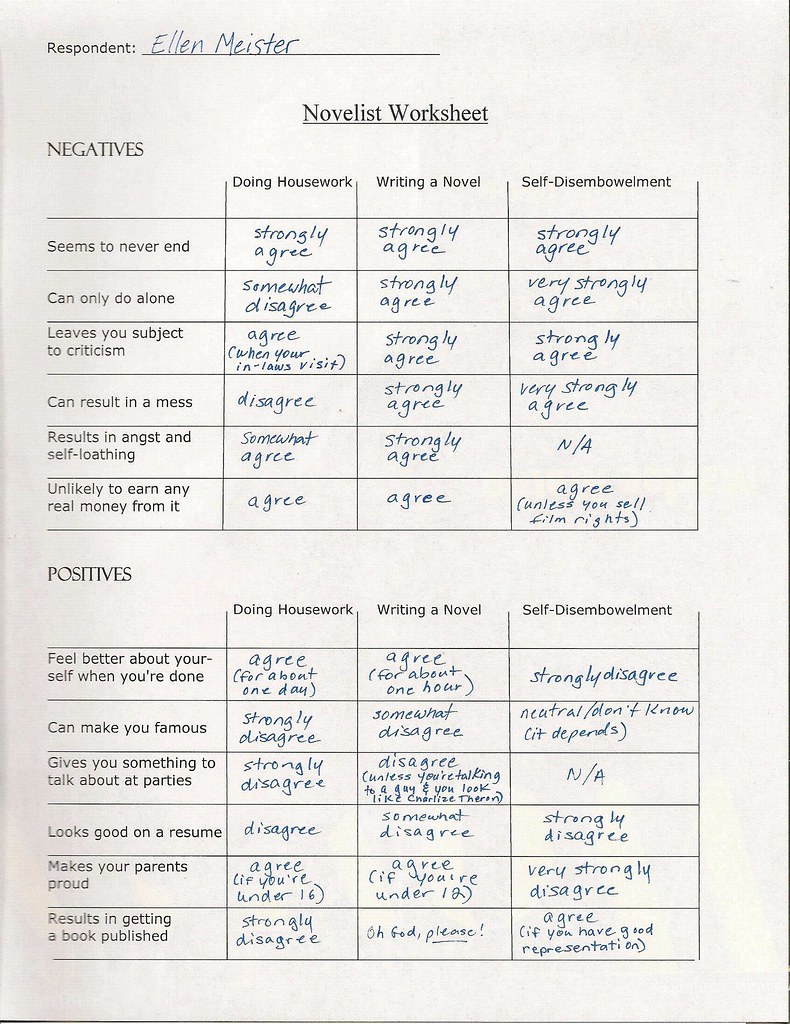
Finally, I decided to attack the dilemma with a systematic, scientific approach. So I created the Novelist Worksheet, which allows me to compare and contrast housework and novel writing. Like a true scientist, I figured I needed a third task as a control—something that was clearly less appealing than either. Naturally, I picked self-disembowelment.

Here, submitted for your analysis, are the results:

(click image for larger view)


Kidding aside, what about you? Do pesky things like making a living, doing housework and taking care of kids get in the way of your writing? If so, how do you find the time and discipline to get those words written? Leave a comment below and you'll be automatically entered in a drawing for this very cool t-shirt.


Ellen Meister's new novel, THE OTHER LIFE, comes out this February from Putnam. She hopes you'll click here to read more about it, perhaps even pre-order. In any case, please sign up for her mailing list (there may be big news coming down the pike soon). Ellen can also be found on Twitter and Facebook.

Wednesday, December 8, 2010

On Nostalgia, and Other Guilty Pleasures

Sheila Curran is the author of DIANA LIVELY IS FALLING DOWN and EVERYONE SHE LOVED

I bought an advent calendar yesterday, knowing my children are too grown up for such things. For just one rose-colored moment I found myself missing the days when my kids counted the seconds ‘til sundown when they could pop open yet another door for a chocolate treat, ticking off one more joyful day to Christmas.


Then I happened upon this essay I wrote in 1999. Ah, maybe they were the good old days, but I was too busy to notice at the time.

So for all you mothers out there, being envied by those whose ‘blessings’ have grown up, this one’s for you.

 
Yes, Virginia, There is a Perfect Christmas After All 


Each year I start the Advent season anew, moved by nostalgia, or more properly, amnesia. I can’t seem to stop myself. Come November, I’ll actually believe I’m going to make handmade gifts for friends and neighbors. I’ll actually believe that my spare evenings will be spent relaxing in front of a roaring fire, penning clever Christmas cards, while my children raptly lose themselves in the pages of a Childrens Literary Classic.


Here’s the fine print on my holiday fantasy. Children and relaxation rarely - if ever - go together. For me doing almost anything with my kids requires a total abandonment of self.  At certain moments, I'm likely to look like a female Stretch Armstrong with a sizable array of nervous tics.

Why?  Well, for one thing, during the holidays, my three year old greets the day lobbying for chocolate. The conversation repeats itself, day in, day out:

“No, Sweetie-pie, we don’t eat chocolate for breakfast.”

“Please.”

“No.”

“But I said please.”

“The answer is still no.”

“PLEASE!  PLEASE! PLEASE!"

“You know the rule. No means no.”

At this point, my daughter begins to cry.

“The answer is still no,” I say, but my tone isn’t calm, it’s not firm, it’s every bit as wobbly as my little girl’s lower lip.

“OH, please, Mommy! Please!"

This goes on until I am the one who is crying. Somehow, I find myself fixing my Sweetie half a piece of toast so she can scarf down an egg-sized Christmas ornament made entirely of chocolate.

Having flunked the parenting-with-backbone quiz, I comfort myself by imagining the fun we’ll have doing holiday baking together. Here, imagine is the operative word and together is the spoiler. While I may begin with a notion of adorable star-shaped Christmas cookies with white and silver frosting, we will end up with Ameoba-shaped globs covered with what looks like mud but is actually what happens when a Jr. Male Scientist has poured all the food colorings into the same undersized container to see what would happen.

Oh well, I‘ll sigh. Maybe I’ll get my artistic jollies later, when we wrap presents. Somehow though, by the time I’ve finished doing the dishes, the wrapping supplies I assembled only moments earlier have been altered beyond recognition. The foil wrap is a crumpled bundle of fine lines and crow’s feet, the wonderful Glen Plaid has been shredded into tiny small scraps, pine cones are bleeding gold dust, and the tape has joined the Witness Protection Program. Instead of the smartly-wrapped presents with inventive decorative trim I’d seen in the Hollywood version of my life, I’ve landed in an out-of-focus home video, using Barney stickers to wrest together the ends of a confounding trapezoid of mismatched wrinkly-bits.

You would think, after days of scraping small scraps of Glen Plaid off a floor that is sticky with mud-colored icing, I would get the picture. I would realize that this whole Christmas spirit thing is a big fat sham perpetrated by the International Chocolate Cartel and the scotch tape industry. Somewhere in Mommy Purgatory, just around Labor Day, it’s surely being mass-produced and pumped into our veins along with those exotic-flavored-coffee cravings and a sudden desire for electrostatic dust cloths.

Even with Christmas two weeks away, however, I cling to the illusion of long winter evenings in front of that fire.

Ha! Not one of my chores has been reduced. In fact, both paying and household work sit undone in the week before school lets out, a period of command parental participation in activities conducted entirely on miniature chairs, begging my preschooler to please just mouth the words to the carols she’s been belting out at home. My one spare evening is spent devising an angel costume (surprise!) after the stores are closed (surprise!) for our candy extortionist who will be crushed if she can’t glitter like the rest of the children while climbing into my lap and hiding her head from the Three Wise Men.

Yes, that's my hand, and yes, she's just about to cry because she's so nervous!
By the time school lets out, we are absolutely in need of a break. There isn’t a pair of clean underwear in the house, the sheets haven’t been the same since their audition for the Bethlehem Players and the pantry’s sole occupants are arcane cookie ingredients that will eventually bite the dust without having fulfilled their golden-doughed destinies.


“Now,” I sigh, handing over the carefully-chosen, horrendously-wrapped teacher’s gifts. “Now my holiday will begin.”

Somehow, though, the chaos continues. There is traffic, parking, shopping and spending, all in service of creating a “magical” Christmas. There is my son, whose friends have all left town. He has become permanently connected to his video controls when not tormenting his sister in hopes of making something, anything, happen. There is my overtired daughter, whose nerves are shot by Santa’s omniscience regarding misbehavior.

By Christmas morning, the verdict is in. I spent more than I planned on too many presents that were opened in five minutes and consigned to a large plastic bin while my daughter cuts Xmas wrap into tiny pieces and my son is lost in the fog of war, via Nintendo.

I’ve finally earned my long repose in front of the fire, but I just can’t relax. I’m too busy wondering why I’ve done all this, worked myself into a frenzy trying to be the perfect mom, the perfect housekeeper. My husband and kids don’t give a flying sleigh whether our house sparkles, our cakes are made from scratch or our ornaments catch the light. So why do I?

It hits me suddenly that while the right hand was feeling vexed that it never got to do what it wanted, the left was feeling so guilty about such un-Mommy-like emotions that it was singlehandedly trying to reincarnate Donna Reed, June Cleaver and the whole Mothers’ A-team from my Fifties childhood.

After I’ve reconciled myself to this, I do begin to see that I’ve been expecting the impossible. My picky eater is not suddenly going to crave beta-carotene, my curious son is not going to resist the impulse toward messing around with color potions. Neither of my “hands-on” children is going to sit by serenely by while I use that wonderful shiny wrap to create right- angled preciousness. Furthermore, even on my best days, my house is not immaculate. Santa may be good, but he’s not that good.

Or is he? I ask myself.  After all, our house is not completely devoid of holiday magic.  It might not be the Mary Poppins super-powers I'd hoped for, but there is definitely some sort of paranormal activity.

Exhibit A: throughout Christmas day, each time I leave the living room, the neat piles of presents I just stacked under the tree will be mysteriously re-strewn into chaotic formation. Balls of crumpled wrapping paper fly spontaneously out of the trash bag and are once again scattered across the rug. Small plastic toys have multiplied like the Loaves and Fishes and are perfectly distributed for maximum damage to the instep of my foot.

Most surprising of all, next Fall, I will look back on this holiday and forget the frustrated expectations, the frenzy, the shame that my house never once got perfectly clean. Come October, I’ll get misty-eyed remembering the absorption with which my daughter minced the wrapping paper, my son’s triumphant cackle as he recreated Universal Dirt Brown Icing, my husband’s delight as he opened an amoeba-shaped bundle containing splotches of petrified mud.

I may not have created a Better Homes and Gardens’ table of homemade gifts.  On the other hand, I may have pulled off a harder trick than that, filtering the imperfections and frustrations of parenting through the lens of a camera held so tight with hope, it can render the past into an infinite series of expressionist, impressionist, chaotic splendor.


Make a comment and be entered to win a signed, wrapped copy of either of my books. (I’ll post the winners in the comments section the day after this blog is published.  Do check back so you can see if you won!  I'll ask you to email me your information so I can send you your prize.)